Hevy: Turning Workout Data into Smarter Training Decisions
The target outcome: Increase training consistency by helping users train at optimal intensity.
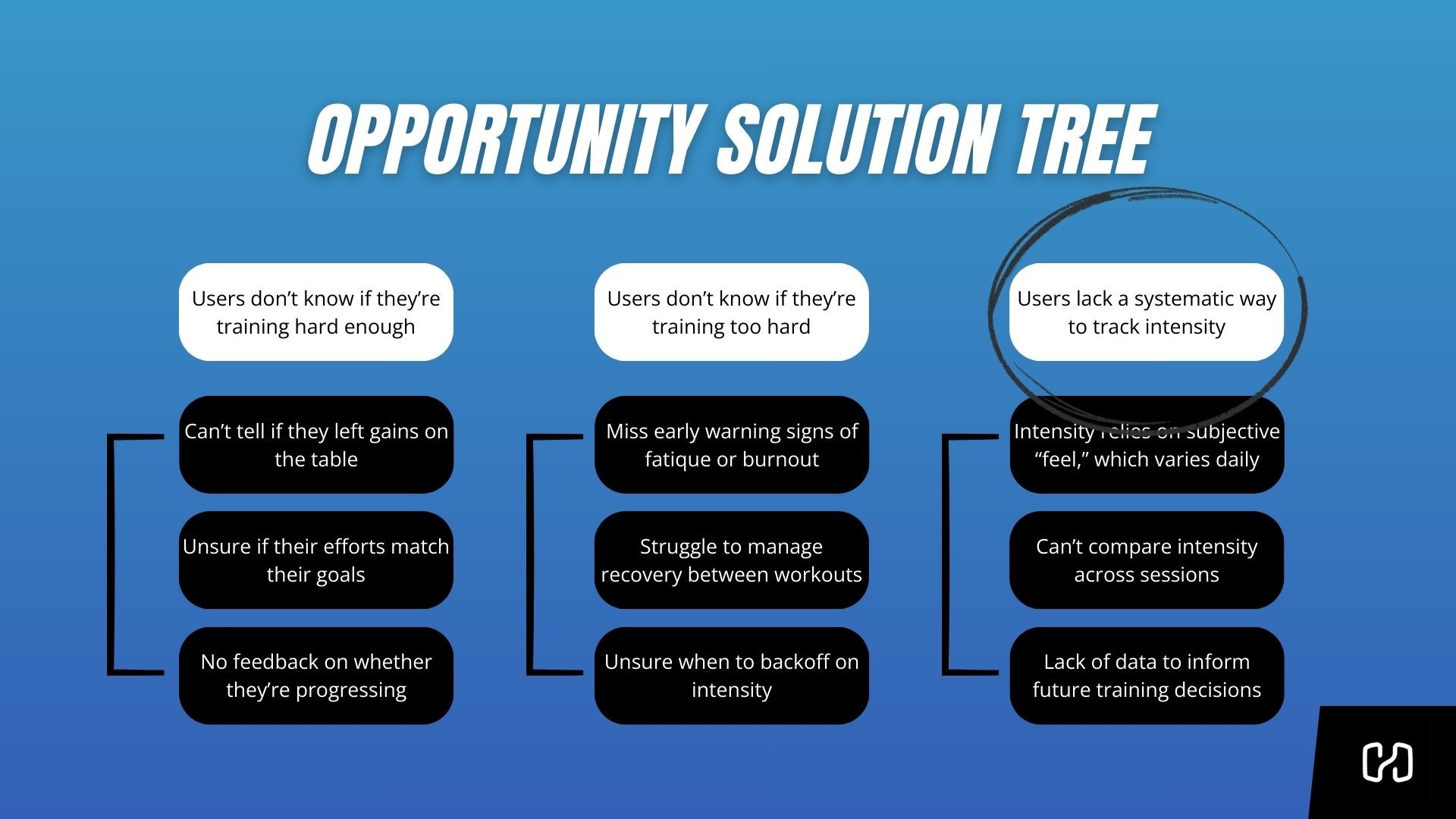
The opportunity I chose to pursue: There are multiple opportunities to consider in order to reach our target outcome (as seen below). I'm exploring how users lack a systematic way to track intensity. I used r/Hevy to understand user pain points and determined this opportunity as the most vital to reaching our target outcome.
The Science
Reserve based training is a style of training that uses perceived exertion to maximize progressive overload.
Reps in reserve (RIR): At the end of a set, this is the number of additional reps the lifter could do until he/she reaches failure
Undertraining: RIR-based training ensures adequate stimulus by providing objective feedback on effort, preventing lifters from leaving too much in the tank.
Overtraining: RIR-based training prevents overtraining by allowing athletes to adjust intensity based on daily readiness.
The Solution
By combining logged performance with perceived effort, Hevy adapts each set in real time to help users push when they should and back off when they need to.
High-level feature user flow:
Set the goal: The user selects an exercise and target rep range based on their goal (strength, hypertrophy, or endurance)
Log the set: After completing a set, the user logs the weight and number of reps performed
Report effort (RIR): The user reports how many sets they had left in the tank after completing their set.
Adaptive recommendation: Hevy compares the reported RIR to the target intensity and automatically adjusts the next set’s weight or reps to keep the user training at an optimal level.
Too easy
Increase weight or reps of next set
Just right
Maintain the current reps and sets
Too hard
Decrease weight or reps of next set
Built with Vercel v0
Assumptions and testing
The adjusted recommendation feels "right" to users: We need to understand how accurate the adaptive recommendation really is. We will see if the RIR on the next set matches the target RIR. Otherwise, the recommended RIR was incorrect. Our target accuracy is 60% to validate this assumption.
Users who use this feature are more likely to achieve their goals: Does the RIR feature increase consistency in logged workouts? We will decide this with an A/B test. Group A uses this new feature and Group B does not. Over 4 weeks, we want to see that Group A is more consistent than the comparison group, with statistical significance at the 90% confidence level to validate this assumption.
Conclusion
I completed this case after reading "Continuous Discovery Habits" by Teresa Torres. I wanted to explore her frameworks while dissecting a product I use daily. In the future, I would do more user interaction through user interviews and assumption testing. This was not possible for this case, but has been super enjoyable in other projects I've worked on. Time for Hevy to implement my feature!